Overview
Device Agent is an MQTT-powered AI Assistant that turns any IoT device into an AI agent in minutes. Describe a device or upload a hardware definition to generate its specification, SDK, simulator, and IM/A2A integration.
What You Can Build
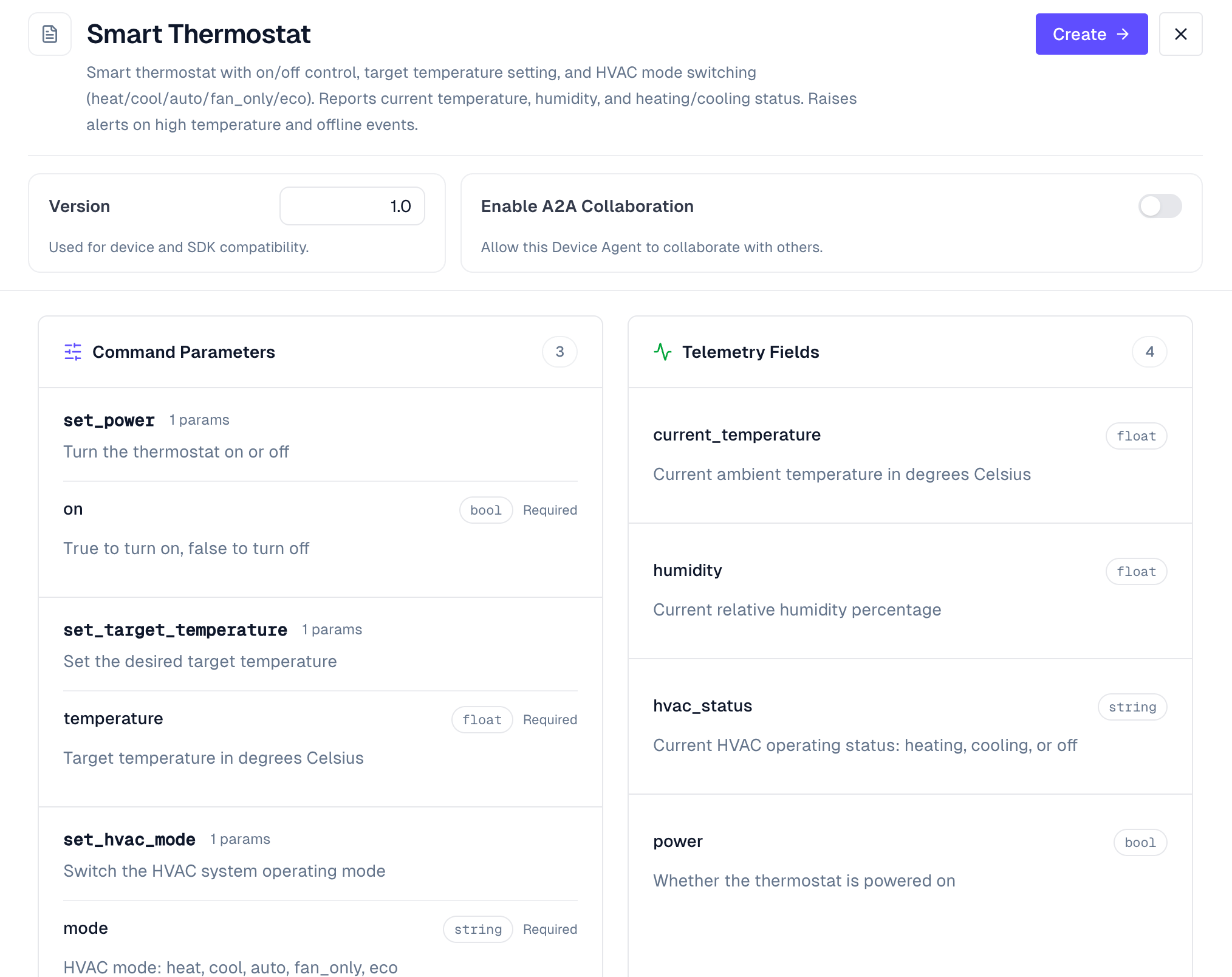
- Define a Device Agent: describe properties, commands, and events, then turn a device category into a conversational, connectable, and collaborative capability model.
- Generate a device SDK: produce runnable device-side code and reduce handwritten protocol parsing and connection boilerplate.
- Debug with a simulator: validate device interaction, command responses, and conversation behavior before the hardware prototype is ready.
- Connect voice, vision, and IM channels: let users interact with devices through natural language, image context, or chat tools.
- Build an A2A hardware network: let device agents discover each other, coordinate tasks, and collaborate across devices without hardcoded automation rules.
Who It Is For
Smart device manufacturers can use Device Agent to validate an AI upgrade path without building a full AI, voice, and multimodal stack from scratch.
AI hardware teams can structure product capabilities in an Agent-native way from day one, giving devices conversational, callable, and collaborative interfaces.
System integrators can reduce one-off private API integrations and hardcoded automation rules, then deliver cross-brand device collaboration through standard protocols.
Developers can start from device models, MQTT access, SDK access, simulator flows, and A2A examples to understand the complete engineering path.
Application Scenarios
Smart Cockpit
Cockpit devices come from multiple brands with fragmented atomic capabilities. Traditionally, developers must integrate with HVAC, seats, ambient lighting, audio, and other modules one by one, resulting in long development cycles and high cross-department coordination costs. Device Agent unifies all cockpit devices into Agents, enabling natural interaction through voice and visual fusion—"I'm hot" triggers automatic temperature adjustment and ventilation, while "set ambient lighting to blue" executes seamlessly across domains. It supports splitting functions into multiple intelligent agents, dynamically orchestrated via the A2A protocol, with flexible cloud-vehicle collaborative deployment. Core Value: Dramatically improved development and delivery efficiency, custom scenarios delivered in minutes, and significantly enhanced interaction naturalness.
Energy Facility Management
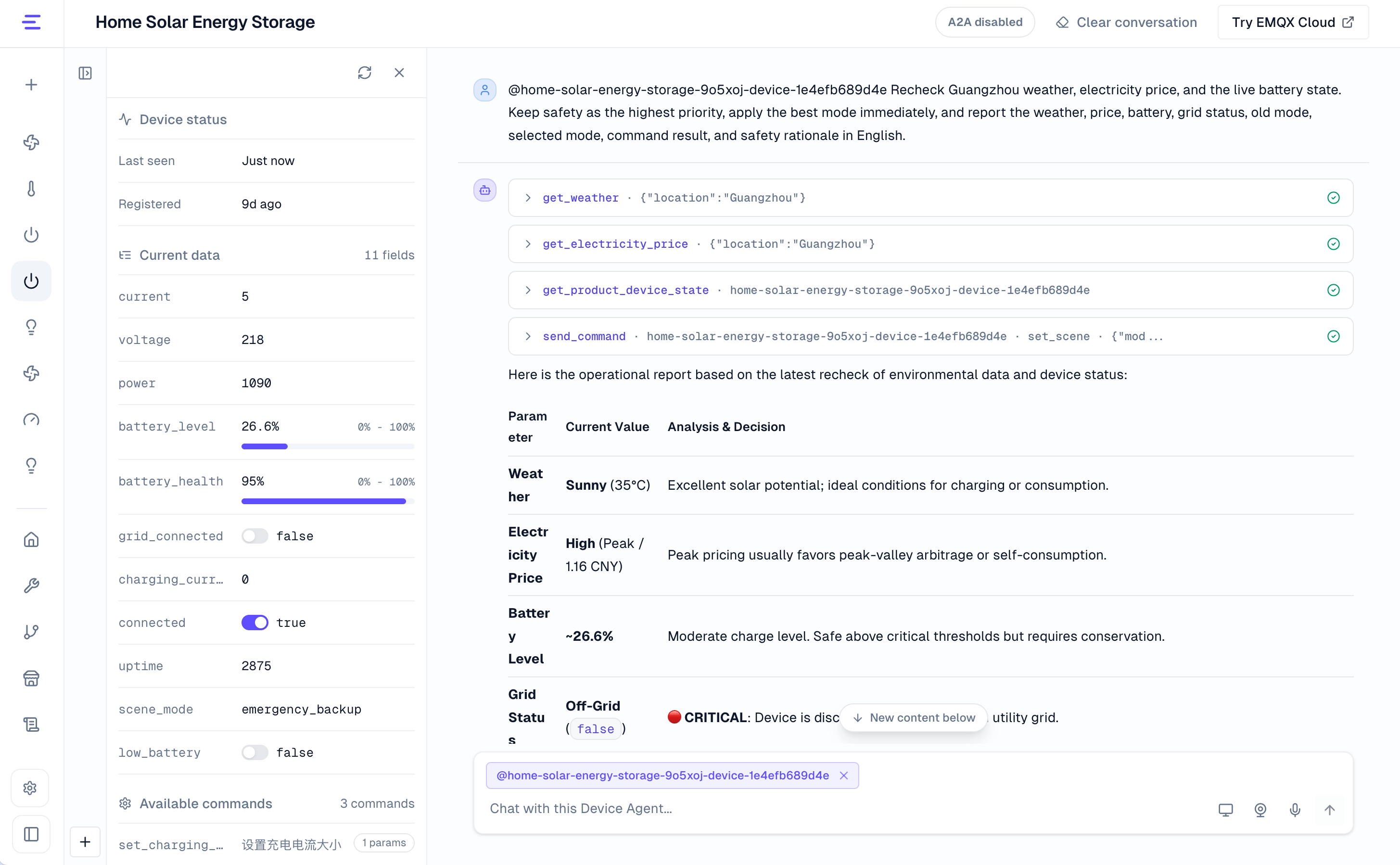
BA building automation, lighting, HVAC, and EV charging systems operate in silos, creating data islands that force energy management to rely on manual experience with delayed anomaly detection. Device Agent breaks down system barriers by unifying multi-system device access and Agentification; Agents autonomously execute energy-saving strategies, dynamically adjusting equipment operation modes based on occupancy distribution, weather forecasts, and peak/off-peak electricity pricing, with automatic anomaly identification, alerting, and work order dispatch. Core Value: Unified multi-system access breaking data silos, AI-driven automatic implementation of energy strategies, shifting from passive response to proactive operations.
Medical Device Assistance
Patient monitors, infusion pumps, ventilators, and other devices scatter data across disparate systems, requiring nurses to check and record readings device by device. Anomalies rely on fixed-threshold alarms, creating long response chains and heavy nursing workloads. Device Agent unifies medical device access through Agentification, collecting vital signs data in real time; nurses can obtain patient trend analysis via voice queries, and when devices malfunction, Agents automatically notify staff with priority assessment and disposal recommendations. Core Value: Significantly reduced anomaly response time, alleviated repetitive workload for nurses, and enhanced patient safety assurance.
Manufacturing Production Line Orchestration
Production line equipment from different vendors relies entirely on hard-coded linkage logic. Line changeovers or temporary rush orders require reprogramming and repeated debugging, resulting in high integration costs and long delivery cycles. Device Agent defines machines, AGVs, material racks, and robotic arms as independent Agents, enabling autonomous discovery and collaborative negotiation through the A2A protocol; when production lines need adjustment, operators can reconfigure device collaboration workflows with a single sentence, eliminating the need for reprogramming. Core Value: Line changeover shortened from days to minutes, significantly reduced integration costs, and enhanced production line flexibility and responsiveness.
Smart Home and Intelligent Office
Home devices span multiple brands, each requiring its own app, making cross-brand interoperability nearly impossible; office meeting room management relies on manual processes, with inefficient pre-meeting equipment checks and post-meeting resource release. Device Agent provides a unified intelligent interface for cross-brand devices—"I'm home" automatically turns on lights, adjusts temperature, plays music, and disarms security; meeting rooms are managed across their full lifecycle—booking confirmation, pre-meeting device coordination, overtime reminders, and energy consumption analysis all handled seamlessly. Core Value: Elimination of app proliferation, fully automated space management, and significantly improved office efficiency and living experience.
Basic Workflow
- Describe the device: enter a natural language description or upload a JSON, Markdown, or YAML device definition.
- Confirm the capability model: review property fields, commands, events, and version information.
- Create the agent: generate the Device Agent and enable A2A publishing when needed.
- Connect a device: create or select a device record, then use a browser simulator session or explicitly configure and run an MQTT or SDK device-side client.
- Expand interaction channels: add voice, vision, IM, or external agent network integration based on the scenario.
Choose where to start
For a first run, follow Installation and Quick Start.
- Existing IoT platforms and devices: begin with IoT Platform Integration, then validate queries and control.
- New devices or prototypes: start with Define a Device Agent and SDK Access.
- Enterprise production: see Platform Overview for private deployment, scale, and operations.