Data Monitoring and Device Control
The data monitoring page shows live values collected by southbound drivers and provides the entry point for writing back to devices. After groups and tags are configured, this is the first place to confirm that the collection path works.
View collected data
On Data Collection → Data Monitoring, select a southbound device and a group:
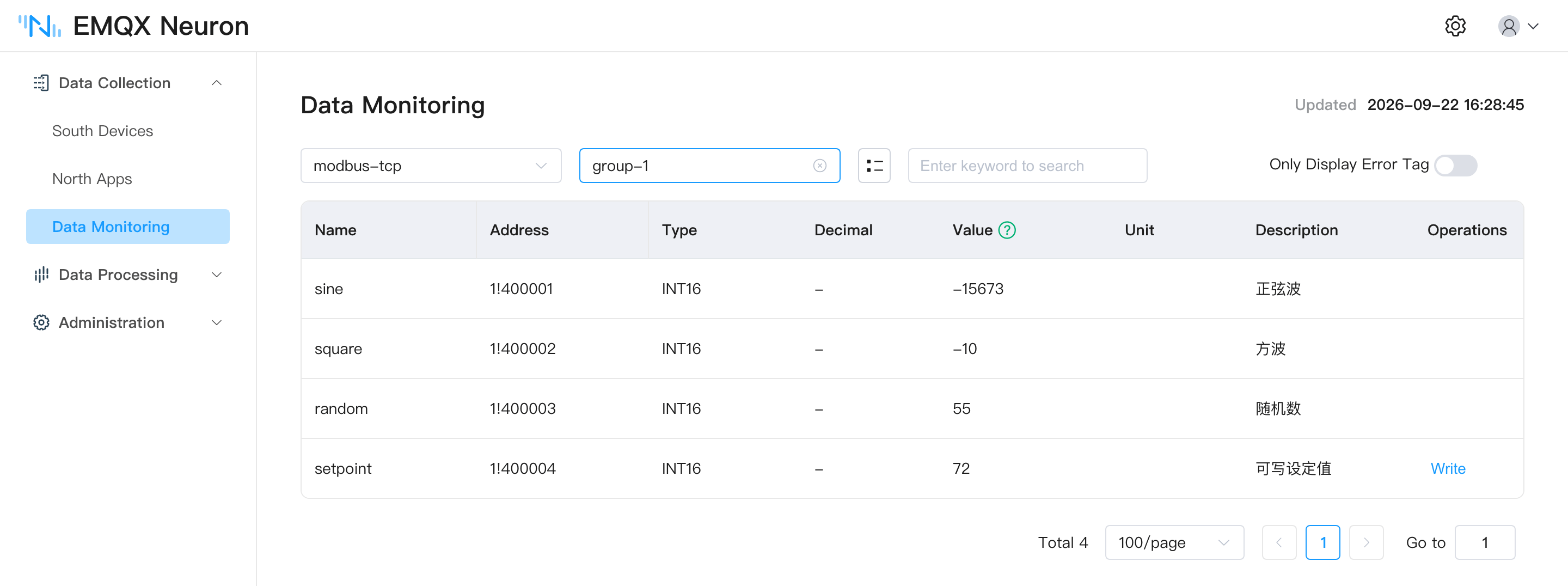
| Option | Description |
|---|---|
| South device | The southbound driver node to inspect, for example modbus-tcp |
| Group | A collection group under that node, for example group-1 |
| Keyword search | Filters by tag name, for locating a single tag among many |
| Show error tags only | Shows only tags that failed to collect. With many tags, this is the quickest way to find a wrong address or one the device does not support |
Values refreshing as the device changes means the collection path works. If they do not refresh, or show an error code, see Diagnosing a connection.
Device control
The EMQX Neuron data path is bidirectional: besides collecting from devices, it can write commands back to change device parameters or drive device behavior.
The target tag must carry the write attribute — see Groups and Tags · Tag attributes. The address must also be writable on the device, or the write fails.
There are four control paths:
| Path | Suits |
|---|---|
| Data monitoring page | Manual testing and verification — see Writing from the monitoring page below |
| Northbound applications | Commands issued by a cloud platform or an upper-level system. MQTT and AWS IoT use a write request topic, Azure IoT uses cloud-to-device messages, Sparkplug B uses DCMD commands, and with OPC UA Server the client writes the variable node directly. See Northbound Applications |
| Data processing | Rule results written straight back to the device, closing a collect → decide → control loop at the edge. See Neuron Sink |
| HTTP API | Integration from third-party software — see the API reference |
For worked examples of all four, see Device Control.
Writing from the monitoring page
When a tag carries the write attribute, a Write button appears at the end of its row:
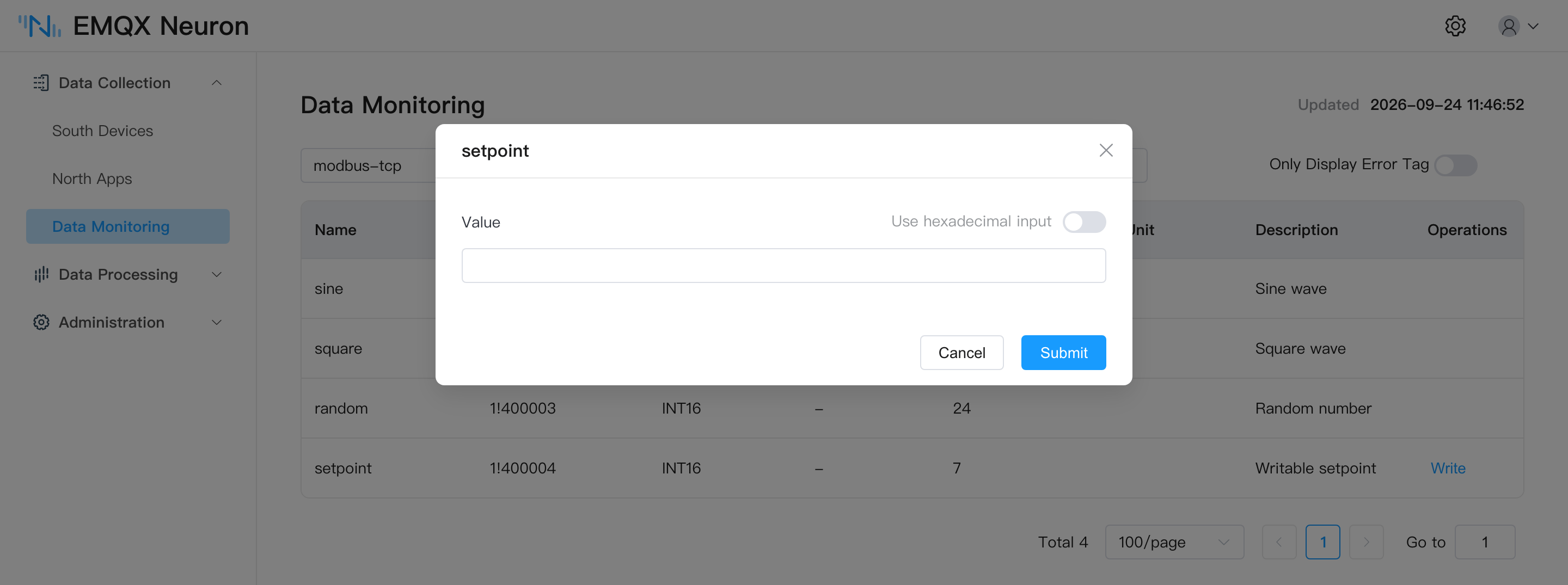
- Click
Writeat the end of the target tag. - Choose whether to enter the value in hexadecimal.
- Enter the new value, for example
123. - Click
Submit.
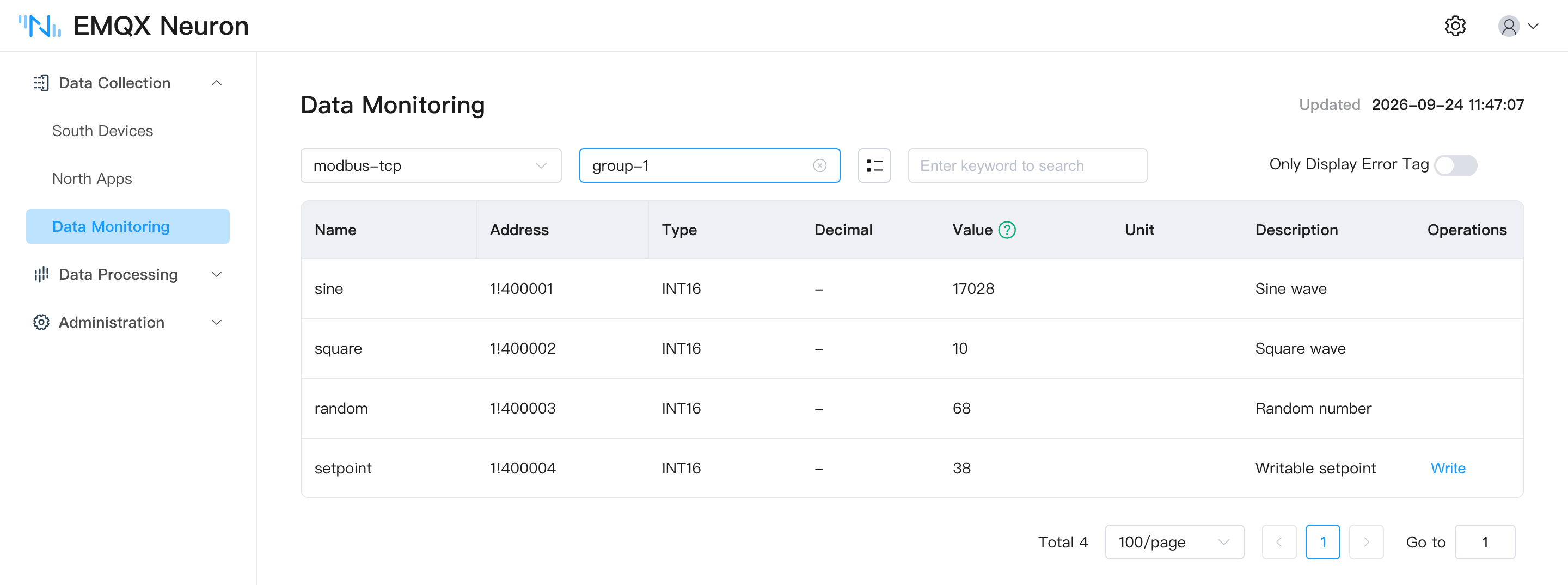
The tag's live value should update to the new value. You can also confirm it on the device or in the simulator:
TIP
If a write fails, check two things first: the tag carries the write attribute in EMQX Neuron, and the address is writable on the device. Bit-level writes to holding registers on some protocols also require the corresponding function code to be enabled on the driver — see the relevant driver page.