Device-Initiated Voice Feedback Scenarios
Unlike user-initiated voice control or conversational scenarios, interactions here are initiated by the device. When a device detects environmental changes or events, it proactively triggers AI-generated voice messages and plays them to the user—shifting from “people finding devices” to “devices finding people.”
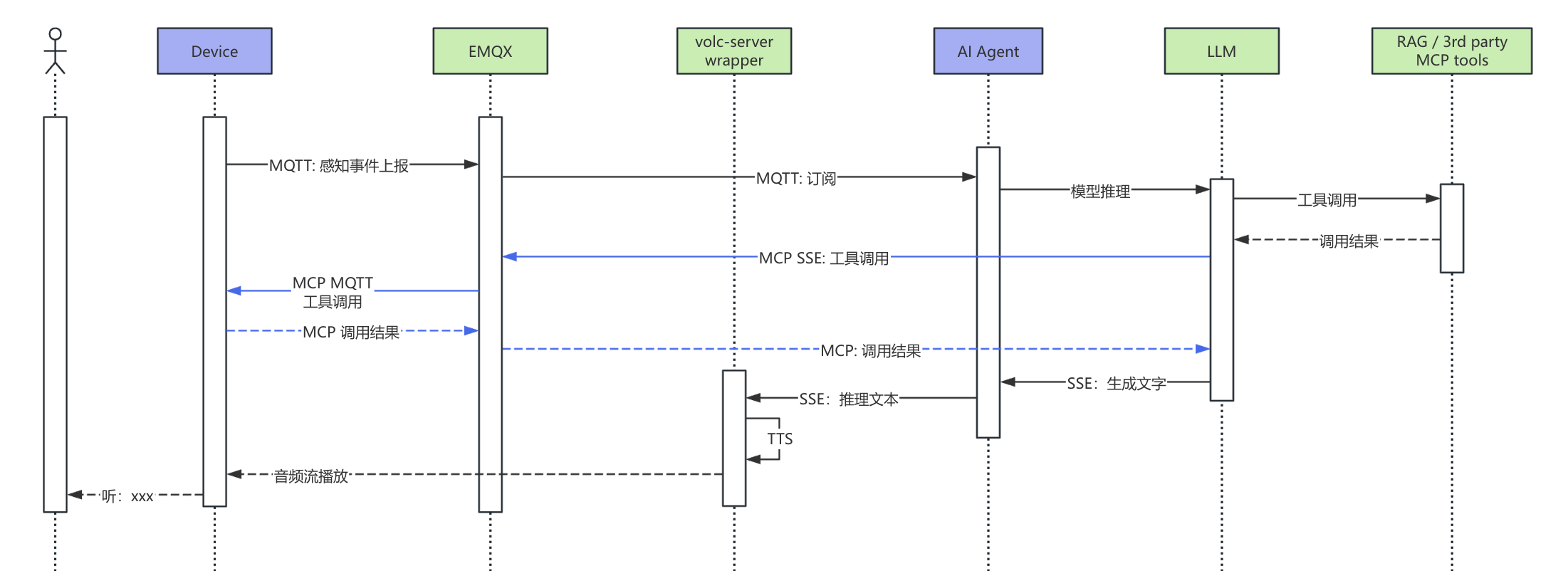
Technical implementation: Sensors on the device (temperature, smoke, camera AI, etc.) detect events and report them to the cloud via MQTT. The AI Agent analyzes the event and generates natural-language announcements, then uses the Volcano Engine UpdateVoiceChat API with the ExternalTextToSpeech command to push text into an RTC room for TTS playback.
Architecture components:
- Device sensors: Detect environmental changes (standard hardware)
- EMQX: Event data ingestion via MQTT (standard product)
- AI Agent: Event analysis and announcement generation (custom-developed)
- Volcano Engine RTC + TTS: Voice broadcast channel (standard product)
Flow Diagram

Flow description:
- Device sensors detect an event (e.g., abnormal temperature, smoke alarm)
- Event data is reported to the cloud via MQTT
- The AI Agent analyzes the event and generates natural-language announcements
- The
ExternalTextToSpeechcommand of theUpdateVoiceChatAPI is invoked - Volcano Engine pushes TTS audio to the device via RTC for playback
Typical Scenarios
Industrial Monitoring — Real-Time Incident Alerts
At 3:00 a.m., the factory is unattended:
(A temperature sensor detects abnormal temperature in Boiler #3)PA system: “Warning! Boiler #3 temperature has reached 285°C, exceeding the safety threshold. Power has been automatically reduced. On-duty personnel, please inspect immediately.” (A phone call is also placed to the shift supervisor)
(Abnormal vibration detected)System: “Attention: Abnormal vibration detected on Motor #5. Possible bearing wear. Data recorded and a maintenance ticket has been generated.”
Immediate voice alerts reduce inspection workload and help prevent accidents.
Child Care — Safety and Companionship
A mother is cooking in the kitchen while her 3-year-old plays in the living room:
(Camera detects the child approaching a power outlet)Speaker: “Sweetie, the outlet is dangerous—don’t touch it. How about we play with some blocks instead?”
(Crying detected)Speaker: “What’s wrong, sweetheart? Did you fall? Mom is coming right away.” (A notification is also sent to the mother’s phone)
(On a hot day, a car temperature sensor detects rising heat and the camera recognizes a child alone in the car)In-vehicle system (voice alert sent to the parent’s phone): “Emergency alert! A child is detected in the vehicle. Current temperature is 42°C and rising. The air conditioner has been turned on automatically. Please return to the vehicle immediately!” (Hazard lights are activated to alert nearby pedestrians)
Devices proactively detect danger and alert caregivers in time to protect children.
Key Technical Points
| Aspect | Description |
|---|---|
| Event-driven | Triggered by sensor data, no user initiation required |
| Intelligent speech | AI-generated natural language, not fixed alert tones |
| Priority control | Critical alerts can interrupt ongoing conversations |
| Multi-channel | Voice + app push + SMS for multi-channel notifications |
Flexibility of the AI Agent
The AI Agent is the most customizable core component. Developers can tailor it to specific scenarios:
- Announcement style: Serious industrial alerts, gentle child companionship, professional medical reminders
- Decision logic: Multi-sensor fusion instead of single-threshold triggers
- Response strategy: Different notification channels and priorities based on urgency
- Context awareness: Incorporate history, time, and user habits for more relevant messages
Comparison with Traditional Rule-Based Approaches
| Aspect | Traditional Rules | AI Agent Approach |
|---|---|---|
| Triggering | Fixed thresholds (e.g., temperature > 50°C) | Contextual reasoning (temperature + trend + environment) |
| Message content | Static templates (“Temperature abnormal”) | Dynamic generation with values, suggestions, and context |
| New scenarios | Requires new rules | Adaptable via prompt updates |
| False alarms | Hard to filter | Multi-factor analysis reduces false alerts |
| Maintenance cost | Grows with rule complexity | Unified agent logic, easier iteration |
Applicable Devices
- Smart speakers / control panels
- Health monitoring bands / watches
- Children’s watches / companion robots
- In-vehicle systems
- Industrial monitoring terminals
- Retail display kiosks / greeting robots